Egypt EU Trade relations improving

The European Union remains Egypt’s largest investors

Three-quarters of foreign direct investment come from EU states, and trade represents a third of the country’s GDP. The has been constant EU assistance and partnership programs since 1998, which established stable relations between Egypt and the EU. The Association Agreement was the most effective agreement when it came into force in 2004. Since this year, the bilateral trade volume has more than doubled to reach EUR 27 312 million in 2017. There has been increasing interest from the EU into Egypt’s new energy projects and other development plans, in which the EU will support through its new revised European Neighbourhood Policy which was launched in February 2016. Between 2014 and 2020, the new European Neighbourhood Instrument (ENI) is the EU primary financial instrument for cooperation and partnerships with Egypt. Over decades, Egypt has been a constant buyer of European weapons, primarily from France but also from Germany and other European countries. 

Trade: In 2001, Egypt and the European Union Member States signed an association agreement in Brussels, the agreement aimed to establish a free trade area over a 12-year transitional period. The agreement came into force in 2004. It states removing tariffs on industrial products and facilitating trade in agricultural products is essential. Further contracts were signed later to promote trade. Between 2002 and 2016, bilateral trade in goods between the EU and Egypt grew by 170% from EUR 10 101 million to EUR 27 343 million. The Association Agreement was extended by the EU-Egypt Action Plan in 2007, which enhanced economic cooperation between Egypt and the European Union states.

In 2017, Fuel and mining products were the EU’s main imports of goods from Egypt at EUR 3 223 billion, followed by chemicals at EUR 1 334 million, textiles and clothing at EUR 8 623 million. The EU main exports to Egypt were machinery and transport equipment at EUR 6 923 million, followed by fuels and mining products and agricultural products (EUR 3 923 million). Egypt’s exports to the EU increased 24% year-on-year in 2017 reaching EUR 7 523 million, while imports dropped by 3% in the same period reaching EUR 18 223 million.

The Egyptian economy has a trade deficit and real economic challenges after the events of 2011 and then  2013. The exchange rate started to fluctuate in 2015. This led to floating the currency, making a devaluation of the national currency and enabling the liberalization of the import system. Some industries, such as the non-hydrocarbon exports gained a profit from the devaluation of the Egyptian Pound.

Egypt-EU relations between 2013-2017: In 2013 the EU and Egypt began discussing how to deepen their trade and investment relations utilizing the Deep and Comprehensive Free Trade Agreement (DCFTA). After hesitations European countries are increasingly embracing Egypt’s new vision for; development, building stability,  combating terrorism, illegal migration, and other economic and social sectors. During the EU-Egypt Association Council in 2017, the parties signed on the revised European Neighborhood Policy, which is supposed to replace the previous Action Plan and made a new partnership, with an allocation range of EUR 432 – EUR 528 million. The assistance program will focus on three priorities: Economic modernization and energy sustainability, social development, and enhancing stability and democracy.

European Business in Egypt

The United Kingdom is by far the largest investor in Egypt, with total investments of EUR 43 723 million over the past decade, followed by Netherlands, Italy, and France. The latter ranks number 12 among the largest investors in Egypt with more than 700 companies. While Spanish investments in Egypt reached EUR 830 million in 2018 alone with 183 companies, most of them in the industrial sector.

Egypt started large projects with many European corporations in the last few years. In June 2015, German firm Siemens won a contract to build three power plants and six substations in Egypt, the most significant order in the firm’s history at the cost of EUR 6 000 million, the contract was supported by the governments of Egypt and Germany. Notably, the number of German firms in Egypt had exceeded one thousand in 2017. Another example of European companies engaging in Egypt is engineering firm CDM Smith and its work in building tunnels under the Suez Canal as part of the last phase of Egypt’s national tunneling system project. Also Italian PV company Enerray which was commissioned to build three solar plants in Benban Solar Park in Aswan, which after completion will be the largest solar installation in the world. The project primarily obtained financing from German bank Bayern, British financing firm CDC Group and Europe Arab Bank as investors in the Benban project.

Energy Sector in Egypt

Egypt is the second largest gas producer in Africa and the largest non-OPEC oil producer in the continent and has been playing a crucial role in the energy market regionally and globally. In 2009 Egypt was exporting nearly third of its natural gas, and as a result of the political struggle that followed the 2011 revolution, the energy sector went into multiple crises when domestic demand outstripped production. Many serious steps were taken to ensure growth and investment in the sector with more focus on renewable energy and exporting natural gas to new markets. It’s notable that Egypt has an abundance of land and sunny weather along with high wind speed, which makes it a perfect location for renewable energy projects, though over decades it has been a challenge for the country to continue its energy developing projects. In 2014, the government started a new energy strategy in which 56 concessions and agreements were signed. The following years included huge investments and promoting new approaches to enhance the energy sector.

According to the Tracking SDG7 Report (jointly prepared by IEA, IRENA, WHO, and others), the total population in Egypt has had access to reliable energy sources in the recent years, though there are other reports depicting many villages in upper Egypt and other areas where people can’t have access to reliable energy resources. By 2022, Egypt attempts to get 20% of generated electricity from renewable resources. Egypt has two liquefied natural gas export complexes, both on the Mediterranean sea cities of Damietta and Idku, the complexes’ joint capacity is 12.2m tonnes per year as of 2015. 

For the 2017-2022 period, the Egyptian government announced the addition of 7,160MW coal-fired power plants with direct engagement of the private sector. Also, Japan’s Sumitomo has plans to build a coal-fired plant at Sidi Shabib in Marsa Matruh on the Meditteranean sea, China’s Shanghai Electric announced that it would build another plant in Hamarwein. Egyptian developer Elsewedy Electric engaged in developing a wind power project in the Gulf of Suez with Japan’s Marubeni. Other projects in 2018 include Enara’s EUR 175 million investment on solar projects in Egypt, and Spain’s TSK investment on Kom Ombo to set up a photovoltaic plant.

Egypt-EU Energy Projects

According to a study of the European Parliment Committee on Foreign Affairs published in 2018, Egypt is currently the only state in the southern Mediterranean area that has the ability to export gas to Europe independently because of the size of its reserves and most importantly because it has proper infrastructure for export. This approach became stronger after Zohr gas field was discovered in 2015 by Italian energy company Eni and followed by other nearby fields. The estimated amount of gas in the place is around 850 billion cubic meters, which makes it the largest gas reserve in the Mediterranean Sea beside the nearby Leviathan gas field. Notably, this amount at the newly discovered Zohr is close to the rest of Egypt’s gas fields combined. According to experts, that would make Egypt a regional Gas hub and an important Natural Gas resource to Europe.

EU assistance and partnership programs to develop the energy sector have been prioritized. The Egyptian Gas Connection Project was recently included in the framework of the revised ENP with a EUR 68 million grant. Moreover, The Egyptian Sustainable Energy Strategy for the period 2016-2020, includes building a new wind farm in the Gulf of Suez. Another reason for more understanding between Egypt and the EU environmental and health issues is that Egypt had taken a pledge to on issues like climate as rising tides will severely affect the Nile Delta region. As salty seawater leeches into low-lying agricultural areas, Egypt could face serious food shortages.

Challenges and Cooperation

Egypt has its challenges and faces regional threats, most experts count population growth as the most critical challenge for Egypt in the following decades. Other areas include education, social justice, democracy, and  vital aspects.  EU is set on building new paths of cooperation and more in-depth economic plans to help Egypt overcome domestic issues while using its role to stabilize  the region. EU officials consider Egypt as the first line of defense against illegal migration, but the country itself still a significant source of migrants.

Egypt-EU relations 2019-2020

Experts believe that Egypt will attract more EU investments by 2020 especially in the energy sector, and an increase in the bilateral trade in case that the two parties agree on removing more tariffs over particular products to make a wider free trade area. For Egypt, it would be a profitable path to increasingly export its products into the EU market. The European Union is confident Egypt’s reform plans, will improve future cooperation. 

More Articles

  • Interview: Lars Van Der Haegen, CEO, Belimo

    Interview: Lars Van Der Haegen, CEO, Belimo

    Belimo is the leading global manufacturer of innovative actuators, valves and sensor solutions to control heating, ventilation and air conditioning systems. How do you assess Switzerland’s business ecosystem? Switzerland is an effective business location from an administration point of view. The business-friendly environment facilitates global networking and offers excellent access to the European market. An…

  • The Evolving Swiss Financial Services Sector

    The Evolving Swiss Financial Services Sector

    A new wave of financial institutions are transforming the field Previously notorious for offshore bank accounts, secret holdings and masked account holders, the Swiss financial services and banking sector has completely evolved, with transparency at the forefront. Switzerland now adheres to strict regulations, requiring institutions to disclose all assets held by American account holders. In…

  • IMD: leading the way in executive education

    IMD: leading the way in executive education

    A conversation with Professor Jean-François Manzoni, President of IMD and Nestlé Chaired Professor January 23, 2020 Switzerland is a small but unique country that punches above its weight in many categories including business, education and innovation.  One Swiss institution at the intersection of all three is the International Institute for Management Development (IMD), the partner…

  • Leading in Fundamental Scientific Research

    Leading in Fundamental Scientific Research

    Interview: Prof. Dr. Christian Leumann, Rector, University of Bern How do you assess Swiss education? Switzerland is known for its quality, and academia is no exception. Most Swiss universities are ranked within the top 1% globally. Switzerland’s education system has several advantages, including the dual education system, which allows the population to pursue different successful…

  • Strengthening Swiss-American Relations

    Strengthening Swiss-American Relations

    January 23, 2020 With informal conversations surrounding a free trade agreement, the bilateral relationship has much to gain What are the Swiss economy’s strengths? Switzerland has proven itself very resilient in the face of multiple global economic downturns. Our federal government has been working with a budget surplus for the past 12 years, before COVID-19,…

  • A Digital Backbone

    A Digital Backbone

    January 23, 2020 Switzerland as a nation is known as a trailblazer, having accomplished many firsts across a variety of sectors, including telecommunications. Switzerland is the world’s largest investor in telecommunications infrastructure per capita, thanks to the nation’s leading telecommunications provider, Swisscom.   Within the competitive telecommunications market, Swisscom has managed to retain its market…

  • Engineering Innovative Technologies

    Engineering Innovative Technologies

    Interview: Roland Fischer, CEO, Oerlikon Oerlikon creates new innovative solutions to tackle some of the world’s greatest challenges. With their engineering technology, they can give products improved and more desirable functions. These applications are specially designed for growth sectors, and utilized across various industries, including automotive, aerospace, energy, tooling and additive manufacturing.  Is global digitization…

  • Interview: Martin Sauter, CEO, Sauter Bachmann

    Interview: Martin Sauter, CEO, Sauter Bachmann

    Based in the Canton of Glarus lies Sauter Bachman, an indigenous family owned success story with nearly 100 years of history. The Swiss precision manufacturing company produces multifaceted high-quality gears, gearboxes and complex systems for customers in industry and aerospace. GE Aviation, Pratt Whitney and other USA clients rely on Sauter Bachman as a crucial…

  • Discover the Canton of Glarus

    Discover the Canton of Glarus

    A hidden gem in Switzerland, Glarus offers Swiss benefits at a cost advantage One hour outside Zurich lies the Canton of Glarus, a picturesque, business friendly industrial region within the Greater Zurich Area. It is home to award winning tourism destinations and wonders such as the geologic UNESCO world heritage site of the Tectonic Arena…

  • Interview: Gilbert Ghostine, CEO of Firmenich

    Interview: Gilbert Ghostine, CEO of Firmenich

    January 23, 2020 Founded in Geneva in 1895, Firmenich is the world’s largest privately-owned company in the perfume and taste business. It has designed many of the world’s best-known perfumes and tastes. The ingredients created by Firmenich are utilized by four billion consumers daily around the world. Firmenich invests 10% of its USD 3.7 billion…

  • The Future of Work

    The Future of Work

    January 23, 2020 A conversation with CEO of The Adecco Group, Alain Dehaze, who promises to continue to make the future work for everyone.  Switzerland is home to a unique labor market that has gained a world renowned reputation for excellence, innovation, and continues to surprise with its qualified youth. How has Switzerland fostered such…

  • Closing the innovation gap

    Closing the innovation gap

    Viewpoint: Marco Huwiler, Country Managing Director, Accenture Switzerland When the world economy catches a cold, Switzerland sneezes. Following weak global growth, Switzerland is feeling the sniffles, with stagnant GDP and a collapse in profitability in recent years. But there is wisdom in the old saying “starve a fever, feed a cold”. Companies with the courage…

  • Dublin’s Silicon Docks

    Dublin’s Silicon Docks

    The nickname alludes to Silicon Valley, and was embraced to illustrate the concentration of European headquarters of high-tech companies Dublin’s docklands were historically a symbol of industrial decline, but today is home to many multinationals including: Google, Accenture, Microsoft, PayPal, eBay, Facebook, Intel, Huawei, Etsy, Twitter, and LinkedIn. Ireland’s tech sector consists of nine of the top ten US technology companies, eight of…

  • Irish Produce Conquers Global Markets

    Irish Produce Conquers Global Markets

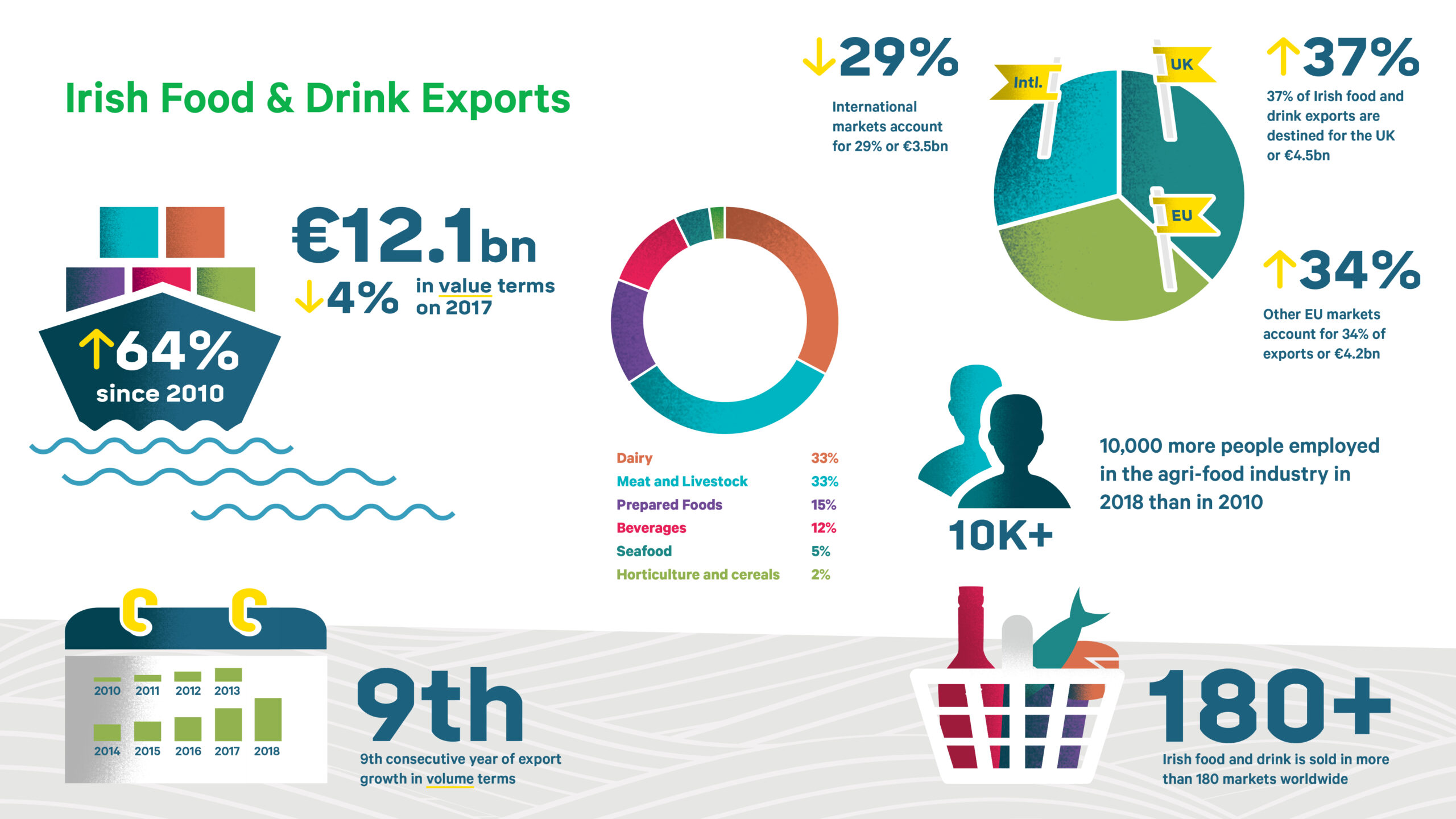
    The Irish agri-food sector is diversifying its markets and pioneered the approach to sustainable food production Agri-food is Ireland’s largest indigenous industry, employing over 8.4% of the working population, and when employment in marketing, processing and inputs are included, the agri-food sector accounts for nearly 10% of total employment. The sector largely contributes to the…

  • An Inside Look at Ireland’s Economic Growth

    An Inside Look at Ireland’s Economic Growth

    Ireland’s polished business ecosystem caters to foreign direct investment and nurtures innovation. The global footprint of Irish companies has never been greater Walking through the cobblestone streets of Dublin, the juxtaposition of modern buildings wedged between historic Georgian brick offices represents the tidal wave of change foreign direct investment has implemented across the nation. Growth…

  • The Midlands: Ireland’s Hidden Heartland

    The Midlands: Ireland’s Hidden Heartland

    Ireland’s Hidden Heartlands is the newest Irish tourism brand, exposing the magic of the midlands region. For over a century, Ireland has been on the top of Americans’ travel destinations, but only recently has the midlands been given the recognition it deserves. Often, investment will follow tourism, and Paddy Mahon, Chief Executive of Longford County…

  • Discover Meath: The Birthplace  of Ireland’s Ancient East

    Discover Meath: The Birthplace of Ireland’s Ancient East

    Meath County has a colorful history, stemming as the seat of the High King of Ireland, and as such has been colloquially dubbed “The Royal County.” It is home to the UNESCO designated World Heritage Site: Newgrange, an ancient burial site older than the Great Pyramids of Giza and Stonehenge. The County’s significance is also…

  • Cork: Ireland’s Second Largest Economic Driver

    Cork: Ireland’s Second Largest Economic Driver

    On track to be the fastest growing county over the next two decades Overlooking the colorful city with a winding river and emerald rolling hills surrounding the parameter, Chief Executive of Cork County Council, Tim Lucey, was proud to showcase his county. Cork is the largest county in Ireland, and home to the second most…

  • Manufacturing: Ireland’s Second Largest Employer

    Manufacturing: Ireland’s Second Largest Employer

    With the arrival of the Fourth Industrial Revolution, smart factories and innovative supply chain integration is transforming the manufacturing sector Manufacturing accounts for over 30% of GDP, 122 billion euro in exports, and employs 250,000 people across 4,000 businesses in Ireland.  “Manufacturing is not the first thing that comes to people’s minds when they think…

  • Project Ireland 2040

    Project Ireland 2040

    The Government’s National Planning Framework and National Development Plan Project Ireland 2040 entails a diverse range of investments being made by the State. This governmental 116 billion euro long-term overarching infrastructure strategy aims to counterbalance the continued growth of Dublin with that of other regions. It seeks to develop cities and regional towns as alternatives…

  • Solving Ireland’s Mobility Challenges

    Solving Ireland’s Mobility Challenges

    Anyone visiting Ireland will notice a deficit in transport infrastructure services, impacting mobility for residents and tourists. Dublin remains one of the last major European capitals lacking a rail connection between downtown and the main international airport. Also, the interconnectivity and reliability of city trains, trams, and bus networks are lagging. However, there is a…

  • An Irish Adventure Awaits

    An Irish Adventure Awaits

    Low hangingclouds sweep across a completely still lake. The water reflects a colorful mountain range. With only the sound of a tussle of leaves blowing in the wind, and a breath of fresh country air, you know – this is Ireland. From the warm welcome on arrival, Irish taxi drivers are well-known for being excellent…

  • Dublin: A Melting Pot

    Dublin: A Melting Pot

    Ireland’s first Japanese restaurant celebrates Dublin’s vibrant demographics Derek and Graham Ryan, Group Founder and Director of award-winning, Yamamori Group restaurants and bars, have firsthand witnessed the evolution of Dublin becoming a global melting pot. With nearly 25 years since the original restaurant’s opening, the Group now delivers unique culinary adventures across three thriving restaurants…

  • Interview: Ciarán Hayes, Chief Executive, Sligo County Council

    Interview: Ciarán Hayes, Chief Executive, Sligo County Council

    Sligo Witnessing Unprecedented Investment Ireland’s new hub for innovation? Sligo is not only a stunning location for tourism, but also a highly practical destination for business, with attractive incentives, high levels of infrastructure, and the ambition to become a ‘smart city.’  What is Sligo’s track record for attracting multinationals?  Sligo has an established track record of…