Private non-profit education institutions are increasingly taking the lead and spearheading quality education in Egypt.
Since 2014, Egypt’s focus on improving the private and public education sector has increased significantly. Vision 2030 has called for an overhaul of the current educational system and looks ambitious and promising. Serious efforts to modernize the education sector from elementary schools to universities are being followed.
History: Egypt has traditionally taken a leading role in fostering regional education. Starting in 1952 and until the 1970’s Egyptian university attendance grew 1 400%, quality improved and attracted students from all Arab countries to study at Egyptian universities. National universities include some of the oldest in the Arab world and historically offered exceptional quality. This position eroded over time led by decreased budgets, falling standards and acerbated by the rise of global education industries in the UK and the US amongst other nations.
Public Education: Egypt’s public education system is the largest across Africa, the Arab world and the Middle East. Primary, preparatory and secondary education has nearly 20 million students in about 60 000 public schools. In 2015, it had 2.8 million tertiary education students enrolled and graduates over 500 000 students annually. 30% of Egyptians avail themselves to the opportunity of tertiary education.
Article 19 of Egypt’s constitution stipulates that “the state shall provide free education in the various stages in the State’s educational institutions according to the law.” Officially, education in Egypt is free, and kindergarten, elementary schools, and universities are financed by the government. Free education in Egypt combined with a ballooning population continues to be a huge challenge for the national budget.
Egypt’s 2019 national budget allocates EUR 5 258 million to pre-university education. An additional EUR 2 483 million of public funds are spent on tertiary institutions which constitute 12% of all students. The United Arab Emirates in contrast allocated EUR 2 430 million for the entire education sector in 2018 while increasingly improving quality indicators.
Government expenditure as a proportion of GDP has fallen steadily since the 1960s. The maximum allocated to education was 5.7% in 1983. The 2014 constitution states 4% of government expenditures should be destined for public education. However, this target is yet to be reached, and current spending is one of the lowest rates of public spending in the region per capita. Depending on the survey this amount translates to between EUR 112 to EUR 261 per student per year.
According to the Egyptian Central Agency for Public Mobilization and Statistics (CAPMAS), government spending between 2004 and 2017 declined from 11.9 % to 7.4 % of the state budget for pre-university education and 3.5 % to 2.3 % for tertiary institutions. For years education continued to receive a smaller percentage while the population continued to grow creating the current dilemma. The natural result has been a dramatic reduction in quality.
The Ministry of Education allocates nearly 90% of its budget to salaries. Nonetheless, teachers are still poorly paid and rely on secondary income. Nearly 30% of teachers lack proper training, and professional development programs are lacking.
Quality standards within public education facilities have led the majority of parents to complement the studies through costly private lesson. In 2018, household expenditure on education exceeds that of the government. To redirect household expenditure dedicated to education the ministry of education in 2018 prepped a law criminalizing unauthorized education centers. The overly general text could easily be applied to teachers offering private lessons.
Planned reform programs are expected to take 14 years and cost EUR 1 310 million in addition to the World Bank loan of EUR 435 million.
Challenges: Over the past few years several initiatives have sought to improve quality. 2019 has been declared the year of education with an increasing national agenda to improve the notoriously underperforming educational sector. New strategies seek to enhance quality, increase overall discipline, and produce skilled youth that can effectively enter the labor market. There is a broad reform program supported by a World Bank loan of EUR 435 million for public primary, preparatory and secondary education. The new program will increase kindergarten capacity by 500 000 children, create 50 000 teaching jobs and introduce 1.5 million tablets to classrooms.
Many schools have poor infrastructure, and teaching styles are rigid offering pupil’s little participation. According to TIMMS 2015 and PIRLS 2016 half of students do not meet international learning assessment benchmarks and rank Egypt at the bottom. Grade four reading levels 49/50, grade eight mathematics 34/39 or grade eight science 38/39. According to the World Economic Forum 2018 report, Egypt ranked 129th globally concerning the quality of education.
In 2013 USAID reported 50% of students with five years of schooling were functionally illiterate. The public Egyptian schooling system for years failed to prepare students for tertiary education and vocational training.
Egypt has ranked quite low on education indicators of the Global Competitiveness Index. The World Economic Forum ranked the skillset of Egyptian graduates at 136th place. This, of course, relates to the overall education system. Egypt has thousands of highly skilled graduates but when averaged with its growing population sets a very low mean score.
Strategy for the Development of Education: The new system aims to move away from the superficial approach to understanding and indoctrination. It seeks to develop problem-solving skills and creativity. Students and teachers will be introduced to modern educational technologies, and the new curricula will seek to enhance critical thinking and general knowledge. It is meant to meet international standards and eliminate the over-reliance on private lessons.
Exams before the fourth grade will be abolished allowing students to move forward without risk of repetition. The national level unified exam will be abolished and replaced with 12 examinations in its place reducing the stress of having a single exam determine the fate of the individual. Digital technologies will play a stronger role seeking to centralize, offer better followup and prevent grade manipulations. New exams seek to judge comprehension rather than memorization. Therefore questions are being rewritten, and students will be allowed to take textbooks into exams to help them solve the new questions. Classroom density will be tackled through new sitting arrangements. 200 000 teachers will be trained through a new “Teacher’s Guide” while salary increases are being discussed.
Private Tertiary Education: The government strategy to improve higher education has three main areas: International Branch Campuses (IBCs), Public, Private, and National Non-Profit “Ahleya” Universities and technology institutes. With private and non-profit educational institutions increasingly taking the lead and spearheading quality education in Egypt, massive opportunities are arising to solve the challenges the public sector has faced.
Private sector investments: The privatization of education is an important national educational initiative to improve quality. Currently, 20% of students are in private schools. Out of 50 Egyptian universities, 26 are private. Although tuition fees are far greater than the EUR 43 in public universities and can reach between EUR 750 to EUR 4 000, it has increasingly become evident that Egyptian households are willing to pay for quality education.
President Sisi in 2018 incorporated new laws to ease the entry of foreign university branches in Egypt. Egypt strives to attract foreign university branches to increase educational and scientific standards which can be applied in national universities as well. Nearly one square kilometer has been allocated within the New Administrative Capital for foreign universities to set up.
For years Egypt has had no long-standing university in the top 500 rankings. Therefore new reforms seek for new universities to be established in Egypt in partnership with the world’s top 50 universities. This has opened investment opportunities for global investors seeking to capitalize on Egypt’s growing population by offering their expertise in educational excellence.
These IBC’s will provide students with the same academic material used at the parent university, award the same degree as the parent university and allocate many scholarships to students and academic staff enabling their education abroad at the parent university.
Results are slowly being seen. In 2019, the Times Higher Education list for the best 1200 universities incorporated nineteen Egyptian universities in comparison to nine in 2018, eight in 2017 and only three in 2016.
Improving the quality of education has been led by established international universities such as American University in Cairo (AUC), the British University of Egypt (BUE) and the German University in Cairo (GUC). The role of non-profit universities in boosting quality cannot be underestimated. Arab Academy for Science, Technology and Maritime Transport (AASTMT), Nile University, Zewail City of Science and Technology, the French University in Egypt and the Egyptian e-Learning University amongst others are increasingly funding improvements to prepare their graduates for the labor market. These non-profits are specializing in preparing students for incorporation into the labor market of the 21st century. A task that many public universities have faced challenges in.
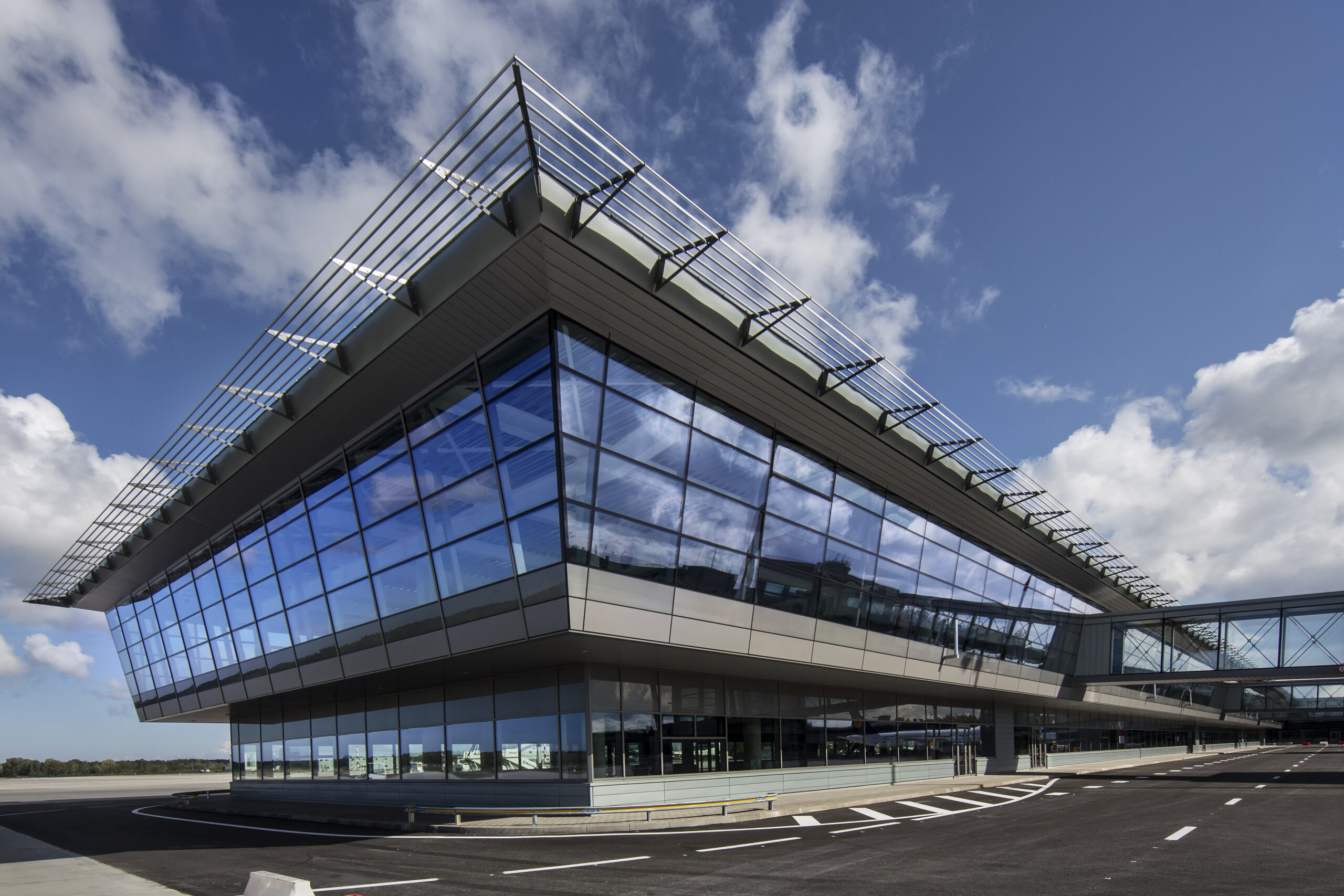
Arab Academy for Science, Technology & Maritime Transport (AASTMT) new campus is located in New Al-Alamein City:
On a land area of 280,000 square kilometers, the Arab Academy for Science, Technology & Maritime Transport (AASTMT) new campus is located in New Al-Alamein City nearly 90 kilometers west from Alexandria and 240 kilometers north from Cairo.
The new campus serves the residential communities in New Al-Alamein and the surrounding cities, including Alexandria and Sidi Abdel Rahman. The state-of-the-art designs remarkably shape the campus providing an attractive educational environment.
The project includes the following five entrances for students, staff, buses, residence, VIP, and includes emergency exits.
The first stages will have an educational campus consisting of eight college buildings including an innovation center, main library, and administrative facilities.
The international school will incorporate services including a nursery, special needs educational building, and the school cafeteria.
A sports complex will incorporate facilities including a playground, courtyards, gymnasium, theatre, VIP restaurant, and school dorms.
The support service buildings will host a mosque, copy center, garage, and transportation building.
While the underground service levels have incorporated MEP utilities, workshops, lockers, services, kitchens, laundry, garbage collection and the parking lot.
Unemployed graduates: 35% of higher education graduates are unemployed and find a job market that is oversaturated with qualified professionals. Egypt’s educational culture promotes the study of traditional careers in law, medicine, or engineering, amongst other academic subjects for which there are limited job opportunities in the labor market.
Unemployment is higher amongst highly educated graduates as they do not want to work outside their area of education and 30% would understandably refuse employment offers that do not match their level of qualification. Many graduates are not prepared for the 21st-century job market. They have Masters and Ph.D.’s in fields that are already oversaturated in Egypt. The Egyptian government is Africa’s largest employer and previously hired many new graduates. Financial challenges are increasingly creating necessary and long overdue cutbacks in the public sector while the private sector is not able to absorb the highly specialized recent graduates. Therefore many Egyptians seek to migrate to find better employment opportunities abroad.
Alternative non-academic and vocational paths that offer better employment opportunities are culturally discouraged. Vocational training is a top government priority. However, stronger efforts are required to boost their cultural appreciation which should encourage future generations to consider non-academic and vocational career paths.
Al Azhar: There are both secular and Islamic paths to education in Egypt. Al-Azhar mosque has served as mosque and university since 972 AD and gained its university status in 1961. It shapes educational, cultural, and religious areas in modern Egypt. Its Al-Azhar University represents this second educational path. It is considered the oldest university in the world although it evolved differently from the European university model.
Islamic education is popular amongst those aiming for careers in religious life. It focuses on cultural heritage with little emphasis on creative thought or problem-solving skills. Nonetheless, the school also offers programs in business, economics, science, medicine, engineering, and agriculture. This modern curriculum with secular subjects has solidified Al-Azhar’s role in education.
Outlook: Egypt is again working to increase standards and regain the confidence of Arab, African and national students. Restricting the autonomy of schools and universities could undermine quality. Educational reform requires additional stakeholder participation by parents, teachers, students, and administrators to ensure their effectiveness.
Tackling historical problems of increasing youth illiteracy and low-test scores requires heavy financing for the refurbishment of classrooms, raising of teaching salaries, and offering quality training for educators.
Furthermore, an over-reliance on traditional university education degrees has caused an overabundance of graduates. Egypt must tackle the populations cultural disregard for vocational training and boost the respect of these career paths to encourage youth to take them. This type of education and training will have the most straightforward economic impact.
The government’s vision for education creates many business opportunities for education-centric businesses. Local investors are increasing their investments in education by expanding their infrastructure, and many opportunities exist for foreign investors to partner.