The Egyptian government is implementing an ambitious strategy to improve and develop the transport sector to enhance the state resources and benefit on Egypt’s strategic location.
Egypt has 108 000 kilometers of roads and 9 750 kilometers of railways, along with 20 airports, 15 harbors and a series of land ports. Transport and logistics represented 3.1% of the GDP in 2015. Egyptian government considers transport infrastructure one of its priorities and believes that the progress of a country is measured by the extent of advance it makes in its infrastructure. Transport services are linked to the total development.
However, many challenges are facing the country. In 2007 Egypt was ranked 97 in the World Bank’s transport and logistics performance index. In 2018, the country jumped to 67, but still, there is a long way for Egypt to achieve its goals for modernized transport infrastructure. The sector faces multiple challenges, especially connecting cities in Upper Egypt. Reports show poorly planned strategies historically affected the development of the sector. A recent drive to urbanize Egypt has modernized its transport infrastructure and seen billions of euro invested across Egypt.
Between 2014-2018, Egypt completed the construction of multiple roads with a total of 8 000 kilometers at the cost of EUR 4 119 million. Egypt developed 2 500 kilometers of old roads at the cost of EUR 13 887 million and established 20 bridges. Alexandria Tram (13.7 km) was renovated at the cost of EUR 363 million. Also many development projects on the railways and Cairo metro which are supposed to reach a combined length of 295 kilometers by 2025 instead of the current 77.6 kilometers.
Egypt and Saudi Arabia approved a project to establish a 32-kilometer sea bridge to connect the two countries through Tiran Strait. The project will cost about EUR 3 473 million and will allow cars to cross it, along with a train track for passengers and cargo. The project is still under study but would benefit regional integration.
Egypt will require EUR 586 162 million in investments to meet its infrastructure needs over the next 20 years. Therefore reviving Public Private Partnership (PPP) would be ideal to ensure the PPP Central Unit can ensure only robust projects that demonstrate value enter the market.
Suez Canal: The canal is the fastest and most heavily used global shipping lane connecting Europe and Asia and has historically been a primary source of foreign currency. The biggest national transport project in modern Egyptian history has been the recently completed New Suez Canal which at the cost of EUR 1 454 million was finished in 2015. The project increased potential navigation in its lanes and lowered transit time for ships.
The New Suez Canal shortened transit time from 18 hours to 11 hours. It minimized waiting times for vessels to three hours instead of 11 hours. At maximum capacity, the canal would be able to have a daily average of 97 transiting vessels per day, up from 49 ships.
Egypt’s Suez Canal recorded a historic high of EUR 4 846 million annual revenue in 2018. The Suez Canal Economic Zone (SCZone) reported profit surge reaching EUR 103 million in the fiscal year 2018, an increase from EUR 63 million the previous fiscal year. This placed the SCZone as the fifth most profitable economic institution in Egypt.
The state seeks to benefit from large cargo volumes crossing through the canal through an increase in industrial zones alongside it. The primary goal is to increase revenues to EUR 1 150 million by 2023. The development of the Suez Canal Area Development Project can enhance the Egyptian national economy and turn Egypt into an international logistics center.
Maritime Transport: Egypt is considered one of the most important routes of international trade between East and West. It has a number of commercial and specialized marine ports bordering the Red Sea and the Mediterranean, which supports foreign trade to Egypt and serves as the central pillar for linking maritime, land, river and rail transport.
A comprehensive plan was prepared to integrate Egyptian ports, maximize the competitiveness of each port and develop a range of programs and projects to achieve a boom in the construction sector. Through the establishment and development of berths, the expansion of container terminals and the deepening of navigational corridors the government set the infrastructure for future trade. The Red Sea Ports witnessed the development of the port of Safaga at the cost of EUR 24 million. Hurghada Maritime Port was developed at the cost of EUR 9.8 million. The third basin expansion in the port of Sokhna was completed at the cost of EUR 6.3 million, and new liquefied gas vessels were delivered. In addition, the ports of Alexandria and Dekheila were dredged to increase the depth to 15.5 meters. This allowed the reception of ships with loads of up to 70 000 tons. It cost EUR 5 million.
The Ministry of Transport aims at establishing a network of dry ports and logistic centers with the participation of the private sector in several locations at the level of the Republic. These would link them to the railway network, river transport, and seaports. Initial plans see the in initial phase connecting 6th October and 10th of Ramadan, Burj Al Arab, and Damietta.
Qastal Port was built on an area of 45 000 square meters at the cost of EUR 3.6 million as a new port to support the movement of trade between Egypt and Sudan east of the Nile and to African countries. Construction of the port of Arkin land on an area of 130 000 square meters at the cost of EUR 4.5 million a new hub between Egypt and Sudan in the west of the Nile.
Roads: Official local reports show that the government needs EUR 6 949 million to upgrade the road network in its five-year strategy. In recent years more than EUR 1 000 million has been invested in upgrading and building new roads.
The first was the upgrade Safaga-Quseir-Marsa Alam road which has a total length of 180 kilometers and to construct 35-kilometer road starting from South Safaga to Quseir. The Second is to duplicate the Ras-Sedr-Sharm el-Sheikh road through the Ahmed Hamdy tunnel. The third project is extending the road from Alexandria to Abu Simbel in the South.
Ten National Road Projects going through 900 kilometers were built at the cost of EUR 619 million. One of the most important roads were the development of Cairo / Suez 70 kilometer road, the development of Wadi Al Natroun / Alamein Road 135 kilometer, Alexandria Desert.
Other projects included the development of 2 000 kilometers of the existing road network at the cost of EUR 276 million. This was in addition to reinforcing existing bridges including Tanta / Kafr El-Sheikh road and the road of Mahalla / Kafr El-Sheikh.
The works also established four axes on the Nile at the cost of EUR 92 million.
There are plans to develop urban transport infrastructure in greater Cairo, including metros, light rail, and buses. The government hopes to attract private capital for the initiatives. It hopes it can attract EUR 225 million for the public-private partnership scheme.
Railways: Egyptian railways are the oldest railway network in the world. They started to operate in the 1850s by the British empire during the colonial era. At the turn of the new millennium, a significant percentage of Egyptians relied on trains for transport. However, due to the decline in quality and recurring accidents, many started to choose alternative transportation methods, especially busses.
The total number of passengers was 800 million as in 2015, with 71 000 employers and workers. Improving the services within the Egyptian National Railways will require EUR 10 000 million in investments over the next decade. In 2018, the government signed a EUR 1 000 million contract to import and manufacture 1 300 cabins Russian-Hungarian firm Transmas Holding.
Egypt has 6 700 kilometers of railways with 820 stations, more than half of the network is concentrated in the Nile Delta area. In 2014, Egypt started a project for a new high-speed rail line between Alexandria and Aswan at the cost of EUR 3 038 million. The total line is estimated to be 1 087 kilometers. It will go through three phases, the first from Alexandria to Cairo, then Cairo to Luxor, and Luxor to Aswan. The Cairo-Alexandria line will be 202 kilometers in length with speed ranging between 300-350 kilometers per hour. The trip time is estimated to be one hour and expected to carry between 10-18 million passengers annually. The Cairo-Luxor line will be 680 kilometers in length with expected passengers ranging from 25 to 30 million a year, while the Luxor-Aswan will be 210 kilometers in length. In 2016, Egypt finished its upgrades on the Alexandria-Cairo rail line, the project cost EUR 212 million and was completed through co-operation of Ministry of Transport, Egypt National Trains and Thales company with a EUR 122 million loan from the European Bank for Reconstruction and Development.
The Ministry of Transport has adopted an ambitious program to develop all components of the railway system, including the development of stations, electrical signals, mobile units and passenger cars of varying degrees.
Public Transport: Microbuses are the main form of transportation for commuters who don’t own a car. The metro system has three active lines with stations that are very far apart.
Metro: According to reports in 2019, Cairo Metro carries 4 million passengers a day out of the 18 that travel through the city daily. Cairo Metro started operating in 1987 with one line from Helwan to Ramsis with a length of 29 kilometers. Line 3 was opened in 2012 but is still under-construction and supposed to be completed by 2022. In 2010, the government approved the Line 4 project to start from El Haram to 6 October city.
Cairo Metro has been losing hundreds of millions of euro per year as a result of the low price of the ticket. In addition to 90% of passengers not paying for tickets. Therefore prices were raised from the 1 pound (EUR 0.05) to all stations. Price brackets were introduced depending on the destination with prices ranging from 3 pounds (EUR 0.15) to 7 pounds (EUR 0.33). The raise is supposed to cut the loss and potentially make a profit for the operator. To reduce the number of passengers not paying tickets new automatic doors were installed at the entrance of the metro.
In early 2019, phase 4A of the Cairo Metro Line 3 was launched which cost EUR 1 550 million. The four-kilometer links four stations in New Cairo — Harun, Heliopolis, Alf Maskan, and Shams Club.
Ports: Egypt has fifteen commercial seaports, nine on the Red Sea and six on the Mediterranean Sea. This is in addition to 44 facilities to serve the oil industry, mining, fishing, and tourism. The port of Alexandria is the biggest, and it handles 60% of foreign trade. Egypt aims at raising the port’s capacity from 120 million tons to 370 million tons by 2030. Red Sea Ports Authority is the manager for the nine ports in the Red Sea, Hurghada, Safaga, Portwafik, Adabeya, Sharm el-Sheikh, Sukhna, Petroleum Basin Port, El-Tur, and Nuweiba. The Ports Authority announced new plans to upgrade the ports through 15 projects at an average value of EUR 52 million for each project and eight projects with a EUR 346 million value. Three prominent projects include the constructing of a Liquid Bulk Terminal on 900 000 square meter area with a capacity of 15 million tons of oil a year, operating an Agricultural Crops Terminal on 580 000 square meters area with a capacity of 8 million tons a year, and constructing a Second Containers Terminal with a capacity of 5 million containers a year and based on 2 square kilometers.
Port Said Tunnel Expansion project started in 2014 and was completed in 2017 by the National Authority for Tunnels with a cost of EUR 6 938 million. The project was a necessity to enhance the new expanded Suez Canal through new well-established logistic infrastructure. The port connects the Sinai Peninsula and the Nile Delta through three tunnels under the Suez Canal. Egyptian construction firm Arab Contractors and Orascom took the project with Tunnel Boring Machines provided by German company Herrenknecht AG. In 2015, Egypt started a EUR 442 million expansion development of Safaga industrial port, which has a vessel capacity of 60 000 tons, the project aims at enhancing the industrial activities in the port such as building new units for meat and grain processing and the export of liquid bulk phosphoric acid.
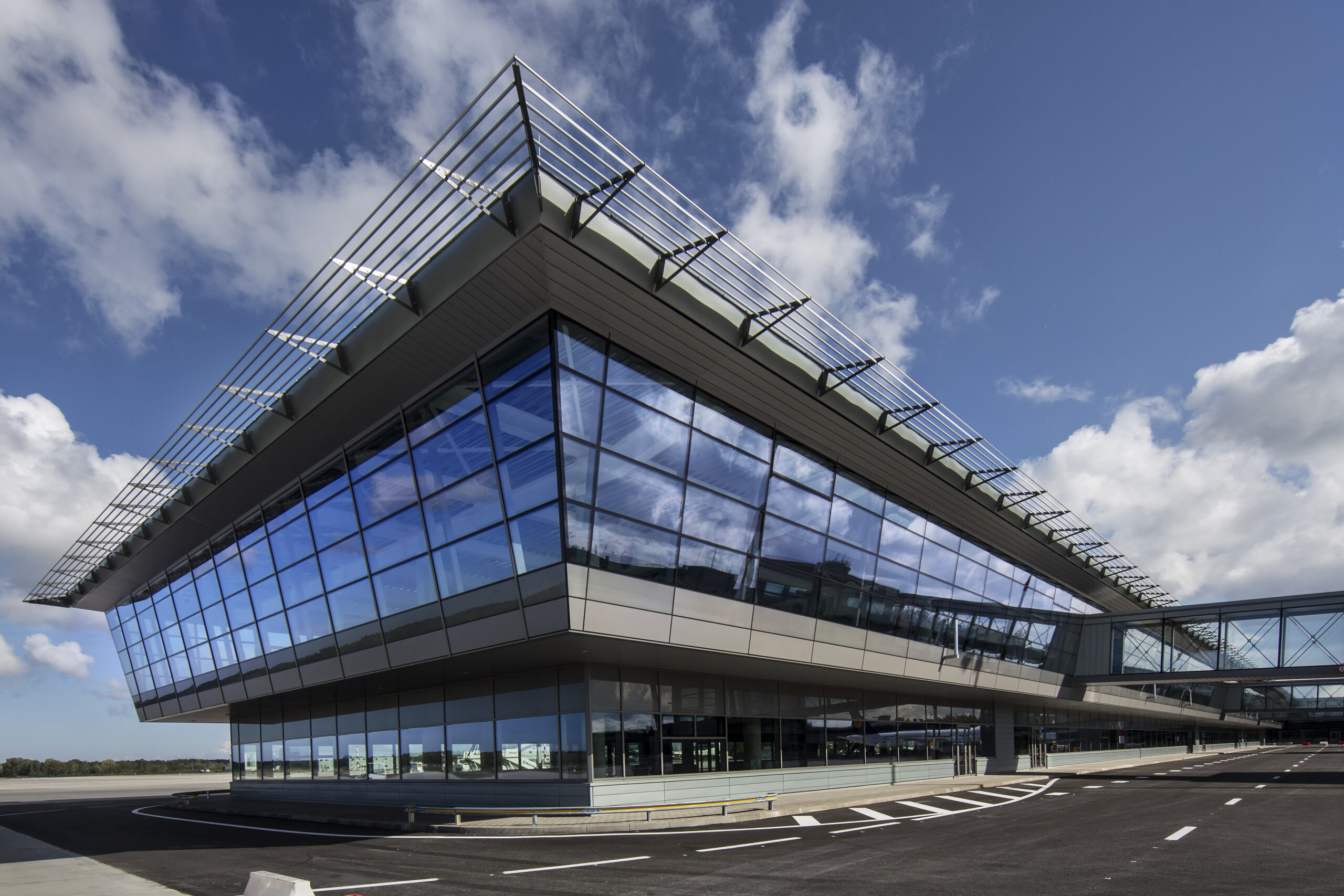
Airports: Egypt has 23 airports, with air links to about 72 cities, as well as 12 Egyptian cities.
To boost the tourism in the country, Egypt works on upgrading specific airports which serve a high number of tourists every year such as Sharm El-Sheikh Airport, which was developed in a project that started in 2013 in-cooperation between African Development Bank Group and Egyptian Airports Company with EUR 320 million investment. The second phase of the project started in 2018.
Alexandria International Airport was also renovated in 2016 at the cost of EUR 104 million.
In 2017, two new international airports were inaugurated in Katameya and Cairo-Alexandria road. Katameya International Airport serves the new administrative capital and the Suez Canal cities, while Sphinx International Airport which is located in Cairo-Alexandria Desert Road mainly serves travelers to 6th of October City and Sheikh Zayed.
In August 2018, Egypt announced the construction of a third new airport which will be within the New Administrative Capital and be larger than Cairo International Airport.
In 2016, Egypt Air purchased nine Boeing 737-800 aircraft valued at EUR 750 million, eight of which were funded by Dubai Aerospace Enterprise (DAE) Ltd.